If you already know the arrangement you want, start by testing how well a candidate follows it. If you are still looking for an arrangement, test whether it gives you an idea worth developing. Those are different selection criteria; one model does not need to win both.
Suno introduced the v6 family on September 9, 2026. This is a selection guide checked on October 14, not an announcement of a new October model. Model roles, access and the controls below come from the current v6 FAQ. The comparison method is our proposed exercise, not a listening benchmark.
Match the model to the decision in front of you
| Your immediate task | Starting option | What to judge |
|---|---|---|
| Try a short idea with access available to all users | v6-mini | Does the musical direction deserve more work? |
| Follow a reasonably settled brief | v6, on Pro or Premier | Did it keep the required structure and role? |
| Find an unexpected direction | v6-wild, on Pro or Premier | Is the surprise usable in this song? |
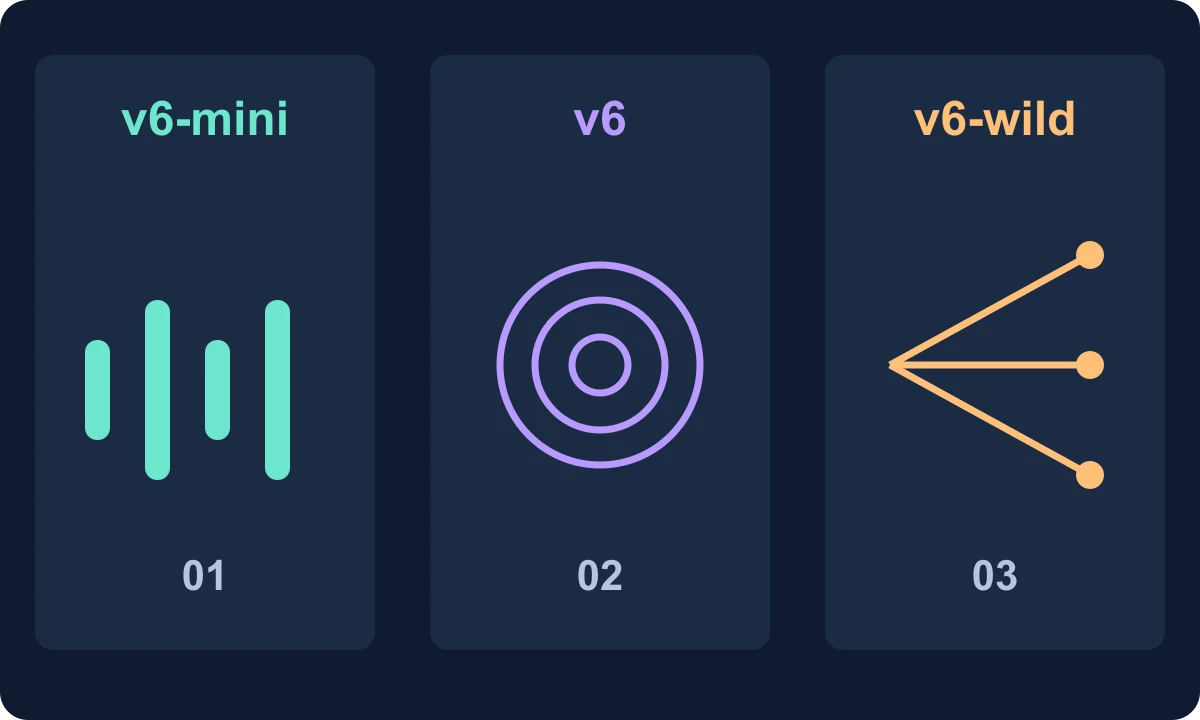
These roles reflect Suno’s positioning, not measured differences in sound quality. A surprising fill is useful during exploration but may be a failure under dialogue that needs a clear gap. Pick the criterion before hearing the candidate, or an attractive sound can quietly change the assignment.
Separate three controls that answer different questions
The model choice sets the starting approach. Variety changes and updates the style prompt to introduce variation; Suno advises setting it to zero if you want to retain full control over style tags. Zero is useful for a more interpretable comparison, but it is not a deterministic-output switch.
Max Mode is a higher-credit option. The FAQ recommends it for songs longer than two minutes, covers intended to stay close to a source, transferring a song’s style, and maintaining vocals and style through a track. It suggests standard mode for short songs and quick ideas. Treat those as vendor recommendations to investigate with your own material, not guaranteed improvements.
The FAQ gives ordinary generation as two songs for 10 credits and notes that multiple image/video inputs can increase cost. It does not give a universal Max Mode multiplier. Check the current request’s displayed charge; a budget calculation based on an invented multiplier will not help you choose.
First pass: hold the brief still
Use this original brief for an arrangement under a spoken introduction. It is a design exercise, not an audio example we generated:
A restrained instrumental cue for a spoken introduction.
Muted electric piano and a sparse bass part, steady 4/4 feel.
Leave space between phrases. No lead vocal or busy drum fills.
Bring in one light rhythmic layer after the opening phrase.
Write three acceptance checks before generating: no lead vocal, enough space for the voice, and one identifiable arrangement change. Use the same wording, source attachments and available settings for the candidates you compare. If you change the model, do not also rewrite the brief or attach a new reference.
Label candidates neutrally, such as A and B, and compare at a similar comfortable playback level. Record one timestamp where each follows or misses the brief. This is practical selection, not a blind scientific test or proof that one model is better in general. Keep a promising idea even if it needs a different place in your project, but do not mark it as meeting the original brief.
Second pass: spend more only on a specific question
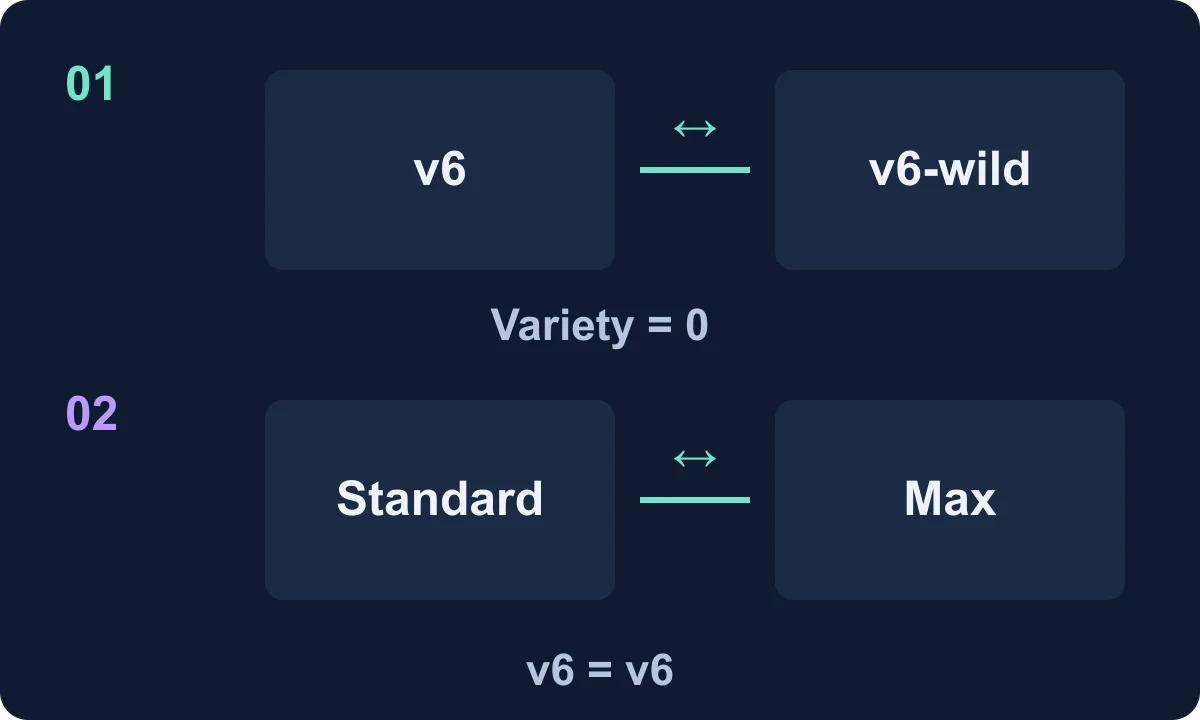
Once a short draft has a useful direction, decide what remains unresolved. If the task becomes a longer version with consistent vocals, a Max Mode comparison has a question to answer. Keep the same brief and model, compare standard with Max, and note the displayed cost before proceeding. For the short instrumental introduction above, extending the experiment simply because a paid option exists has little purpose.
If you are exploring, use v6-wild to find a direction, describe what you want to retain, then investigate it with a more settled brief. Bringing an idea back to v6 is an editorial choice, not a promise that switching models preserves the waveform or arrangement unchanged.
Keep a small decision record and stop
Use four lines for each candidate: settings and cost; required feature retained; specific failure and timestamp; next action. “The opening leaves room for speech, but a fill at 0:12 covers the entrance” gives you a next step. “More professional” does not.
Stop when the candidate serves the intended use, or when repeated versions fail the same requirement and a local edit would be clearer. Use the prompt formula to remove contradictory instructions. For a successful song with one wrong line, follow the local lyric-edit workflow instead of rerunning the whole model comparison.
The FAQ also states that older models have been retired: existing songs remain, while new iterations use current models. Keep the original if its character matters. This guide does not establish commercial rights, which are a separate question from model selection.
FAQ
Is v6-wild simply a higher-quality v6?+
Suno positions it for exploration and less predictable results. That is a different role, not an independently established quality ranking.
Does Variety at zero make results identical?+
No. The FAQ says zero retains control of style tags. It does not promise identical audio or a fixed random seed.
How many extra credits does Max Mode use?+
The checked FAQ says it costs more but does not provide a universal multiplier. Check the displayed cost for the actual request before generating.